Government updates belong in an open feed


Government offices used to use their websites and mailing lists to publish their announcements. Now, the primary communication channel for most officials is a set of accounts spread across social media platforms.
Senators post policy updates on Facebook. City representatives livestream their town halls on TikTok. The county office broadcasts emergencies on X. Mayoral offices are running Reels on Instagram.
Something feels seriously off about this. Officials are choosing to communicate with the public through private platforms owned by different companies, each with its own login, algorithm, and terms of service. It's subtly changed who's really in charge of our government's communications. And it's not the government.
A public social media profile isn't public to everyone
Just because an elected official's account on social media isn't private doesn't mean anyone can view its posts. You need an account on the platform just to see the updates. But many of us don't have an account and have no interest in creating one. Others have intentionally ditched a platform, haven't been on it for years, and don't want back on for legitimate reasons.
Some of us don't want to hand over our name, phone number, email, and sometimes even our driver's license to a privately-owned platform and risk it getting hacked just to see public information.
We might not want to be tracked by the platform so it knows everything we click, watch, linger on, or search for. Because let's be honest, what you do on a platform, especially as it relates to government, is a rough map of what you believe politically. That can then be used against us to manipulate and control our experiences on the platform. And platforms have been known to restrict, suspend, and permanently ban users just based on their political views, or without a reason at all.
A public official shouldn't route their communications through a system that requires us to accept those risks just to see what they have to say. That includes what an official posts to social media.
Officials owe us open communication
We're exactly the people public officials are supposed to represent, and they owe us open communication, especially when it's our tax money that pays their salaries. But they're posting only through a platform that requires an account, an algorithm's approval, and terms to agree to. If this is what officials think public service looks like, this ain't it.
People most interested in hearing from officials are sometimes the least likely to be on the platforms officials picked. Different platforms serve different demographics: TikTok skews young, Facebook older, X leans political, and I won't even go into what some officials use Instagram for. No single platform reaches everyone, so posting on them will inevitably leave someone out.
When an official chooses a private company's platform as the main way to reach people, they're handing control of the office's communication over to that company. The company can now use algorithms and all sorts of biased curation to decide who sees the content, and when. An open feed allows us to see their content unbiased and exactly when it's posted, and puts the office back in control.
Public safety through a private social platform has real consequences
Public safety agencies need to broadcast life-critical information including weather warnings, evacuations, and AMBER Alerts. But when these updates get posted on a social platform, bad things start to happen.
In January 2025, an AMBER Alert went out across California for a missing teen. The Wireless Emergency Alert linked to a post on X. Californians who tapped the link hit a login wall covering the whole screen. Without an account, they couldn't read the alert. A California Highway Patrol sergeant confirmed the problem to press.

And that wasn't just a one-off situation. In July 2023, the same failure hit Missouri State Highway Patrol's AMBER Alerts after Twitter changed its sign-in requirements. And the pattern isn't limited to the US. During Spain's DANA floods in October 2024, the official Valencian emergency alert named an X account, @GVA112, as one of two primary channels for updates.
To be fair, at least one agency's figured it out. The Colorado Bureau of Investigation pulled its AMBER Alert links off X and onto a dedicated site page in May 2024. But many others still haven't.
The White House's feeds are practically invisible
Whitehouse.gov, the website of the highest level of government in the US, publishes two feeds, a news feed and one for presidential actions. But the homepage doesn't link either, and neither includes what a sitting president posts to social media.
By contrast, the site's footer is packed with links to the White House's social media accounts.
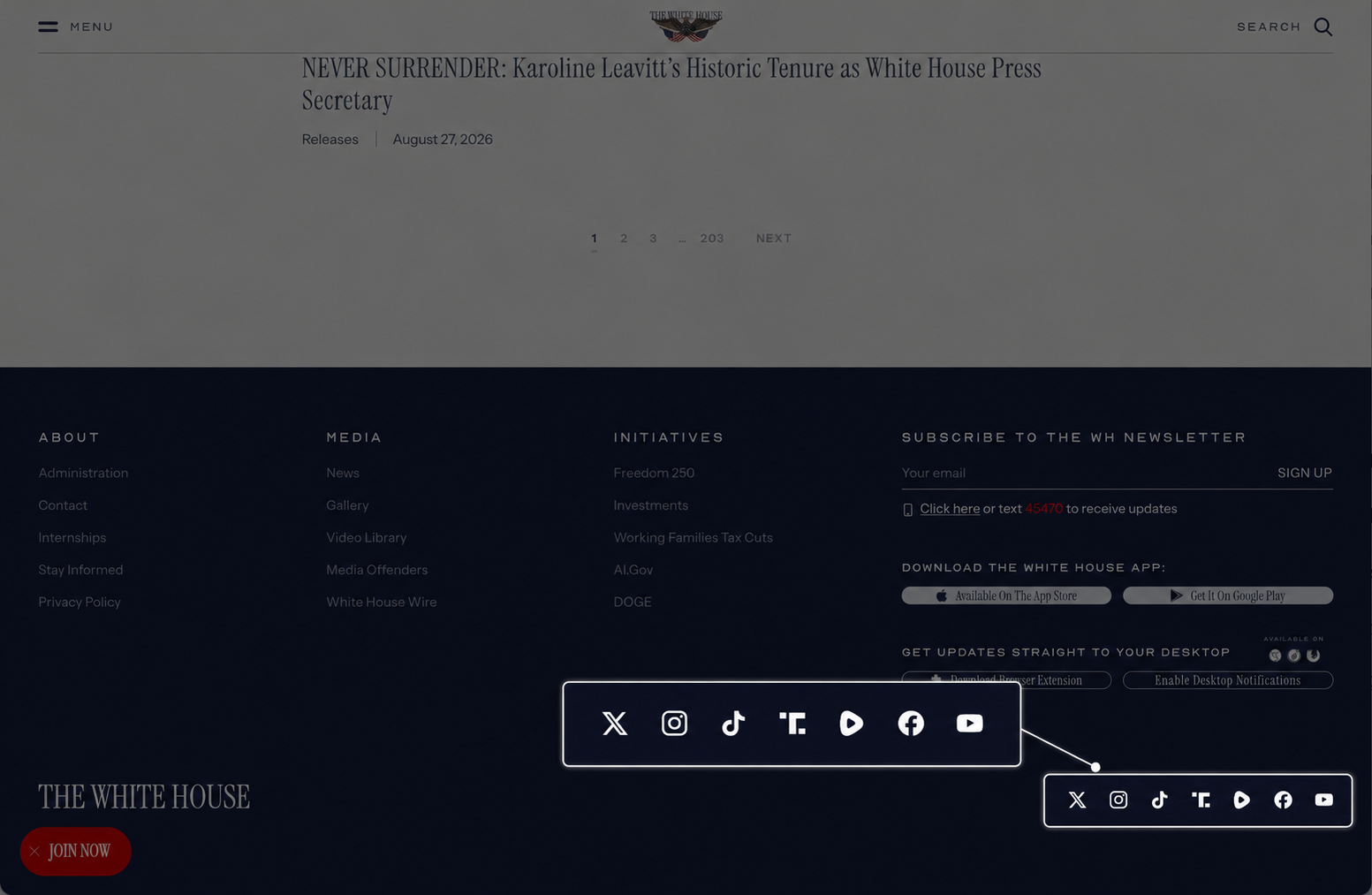
If even the highest level of government in an entire country defaults to promoting private social platforms over its own feeds, it's hard to expect any smaller office to prioritize differently.
Open feeds on a website not tied to a social platform should be promoted. It's how anyone finds out what they are in the first place. When enough sites and apps show a feed icon  or a "subscribe to feed" link, curious people will click through and figure out what it does. That's how any feed gets new subscribers. Right now, most people never see one, so most people never know about it and have no opportunity to learn.
Public statements should survive the platform and the person
Government communications are usually subject to public records laws that require the office to preserve what it publishes. The National Archives has told federal agencies to treat their social media posts as records.
But when a post lives on X or Instagram, the platform is the one in control of it. And we've seen what could happen when a platform is in control of content. They delete, suspend, and outright ban accounts without notice, and change their policies around to cover their tracks when they do it.
The account belongs to the person, not the office. Whatever they posted is theirs to delete, or to keep locked behind a login only they control. Either way, the content is no longer open and accessible, just as if it never even existed.
Give us an open feed
Many government offices or officials already have (or should have) their own dedicated website. Every public communication should go through an open feed on that site, including press releases, announcements, public statements, emergency alerts, and anything else posted on social media.
That way, when any new communication goes out, every feed subscriber automatically sees the content, without ever having to load the site. There's no account to make, no algorithm to fight, and no company in the middle. And it won't matter whether the office also uses X, drops X for Facebook, or moves to whatever comes next, because the feed stays independent from any platform and in the same location for anyone to access. Because it's all coming from one designated place, public statements or posts survive even if the person in office has moved on.

Government agencies, officials, nonprofits, schools, utilities, hospitals, and other public institutions all owe us open communication. And posting only through platforms that gate our access doesn't cut it.