Open feeds
What's an open feed?
A feed is what you see when you log into a social media site like Instagram or YouTube. It's a timeline of the content posted on the site or app, updated as it happens, and it usually contains everything you're subscribed to.

But these feeds belong to the platform, not to you. An algorithm decides what you see, and since the company behind the platform wants you to never leave, it fills the feed with whatever keeps you scrolling, like posts that provoke you, sponsored content sprinkled throughout, and old posts you'd rather not see again. You end up spending more time reacting to things you never asked for and less time on the content you actually wanted to follow.
Open feeds are these same feeds taken off the platform, but better. You can subscribe to a feed for someone's social media profile, a blog, a news site or an online store, without creating an account or logging in to any of those sites. You just add each feed to your feed reader, and with enough of them, you'll have everything you follow on one timeline, with no need to check each website or app for anything new.

Once subscribed to all the feeds across websites you want to follow, you don't have to keep checking each site for updates, and you get exactly the content you chose instead of whatever an algorithm picked for you, along with a long list of other benefits a platform's feed would never give you.
- No ads or distractions. Ads, sponsored posts, "related" articles and pop-ups are stripped out, so you read only what you came for.
- Nothing tracks you. There's no account, and the tracking scripts, pixels and embedded players that report back to the publisher are removed.
- Full articles, not summaries. Each item carries the whole article, so you can read it in your feed reader, even offline, instead of clicking out to the site.
- An end to scroll to. Items stay in order and stay unread until you get to them, so you can stop, come back later, and reach the end.

Once you start using them, you'll find they're not that different from the feeds you see on the websites you visit.
How to use a feed
To use open feeds, all you need is a feed reader. Once you've installed one on your laptop or phone, you can begin adding feeds to it.
-
Navigate
Go to the web page containing the content you want to follow.
-
Add
openrss.org/Type it in front of the page's address in your browser's location bar.
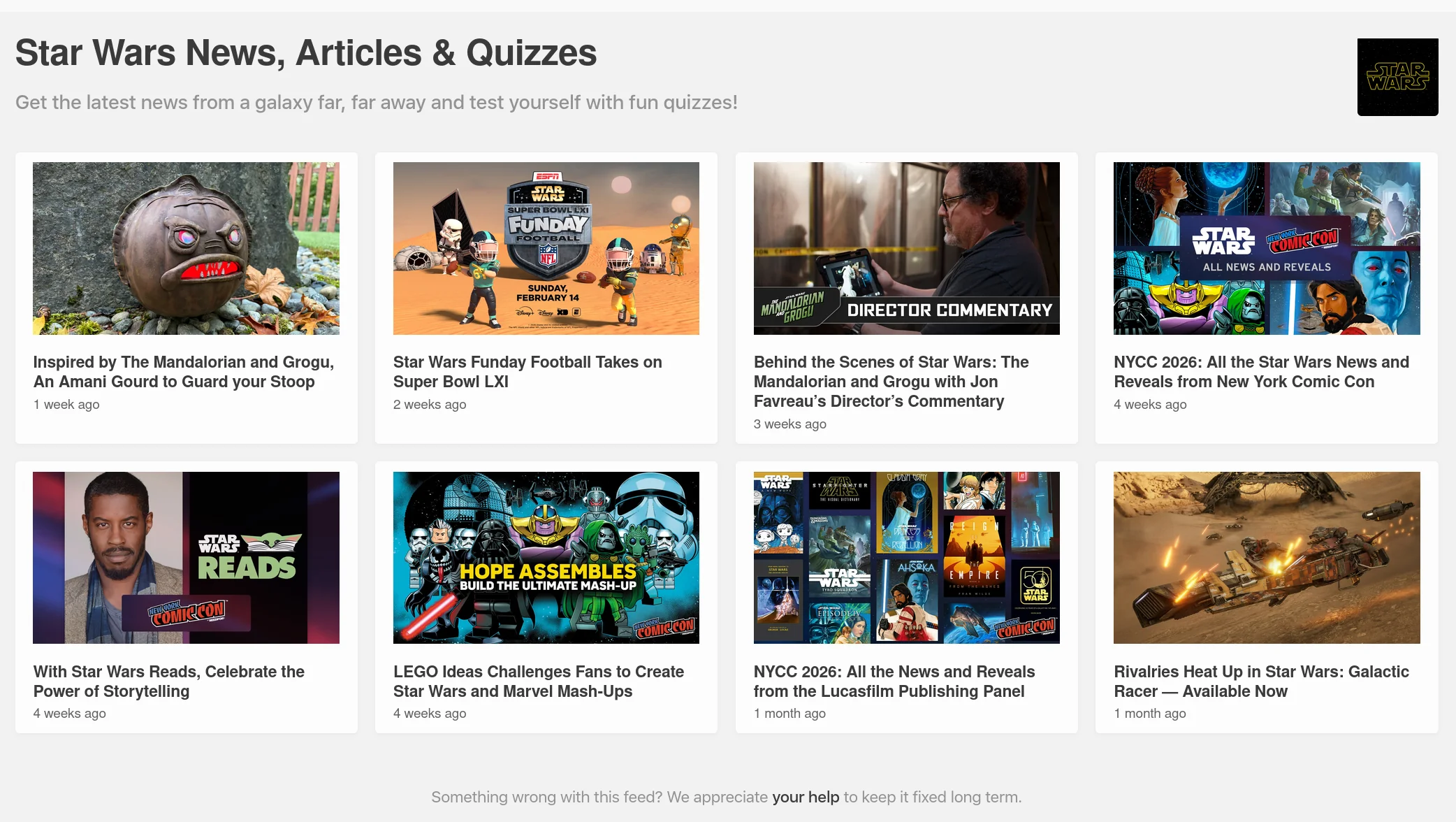
If a feed is available for the web page, a preview page of the feed will show in your web browser containing the same content on the website that matches the URL you entered. It'll look something like this.
-
Subscribe
Add the address in your browser's location bar to your feed reader. Once you're subscribed, whenever the website is updated with new content, the feed will update to include it. And of course, you can unsubscribe at any time by just removing the feed from your feed reader.


If a feed ever stops working in your feed reader, the Fixing feed issues guide shows how to get it working again.
Feed content
What's in a feed
Each feed gets its content from the website you made it for, usually the page whose address you pasted in. Whenever that site posts something new, the feed picks it up, and your feed reader shows it alongside everything else you follow.

Content that's already public will be in a feed. But anything that could get us in legal trouble won't, like content that's intentionally private, sits behind a login, or requires payment.
How often feeds update
A feed stays up to date by checking its website every so often, not every second, since that could overwhelm the site with requests. In between checks, it shows a saved copy, so new posts take a little while to show up, and feeds aren't a good fit for anything time-sensitive or as a replacement for real-time notifications.
How often the website gets checked is worked out automatically from how far apart the feed's last items were published, and it's checked twice as often as that average. A website is never checked more often than every 30 minutes or less often than every 6 hours. Here's how that works out for three website feeds based on how often new posts are published.
| Post 1 | Post 2 | Post 3 | Post 4 | Average time between posts | Website checked | |
|---|---|---|---|---|---|---|
| Feed 1 | 5:00 PM | 7:00 PM | 9:00 PM | 11:00 PM | 2 hours | Every hour |
| Feed 2 | 5:00 PM | 5:01 PM | 5:02 PM | 5:03 PM | 1 minute | Every 30 minutes |
| Feed 3 | 2/15/2022 1:00 AM | 2/25/2022 1:00 AM | 2/25/2022 8:00 AM | 2/25/2022 4:00 PM | 3 days, 13 hours | Every 6 hours |
In rare cases we'll set a feed's schedule by hand instead, like when a website lets us know we're checking it too often. Monthly donors can also ask for a change, as long as it can be done without putting our organization or its resources at risk.
If you're a monthly donor, you can see the last time a feed's website was checked, and how long until it's checked again, right on the feed's preview page. After logging in with the information you received when you began your donation, visit any feed's preview page and you'll find it at the top.
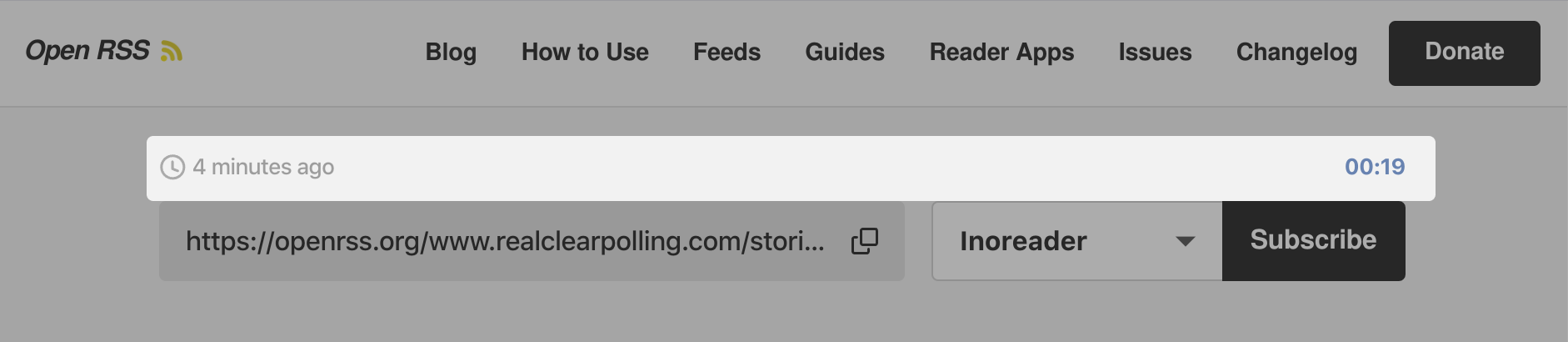
On the left is the last time the feed's website was checked for new content. On the right is a timer counting down to the next check. When the timer ends, you're given the option to refresh the page to show any new content.
Supporting a feed
If a website or platform you want to follow doesn't have a feed, you can ask us to make one. We'll put our own resources into keeping it running for the long haul and fixing it when it breaks, as long as the limitations don't get in the way.
With a one-time donation
If there's a feed you need, and you'd rather not wait for us to get to it, you can offer a one-time donation to prioritize your request ahead of other requests in our backlog. It's a great way to quickly get a feed you want in as little time as possible.
To offer a donation with your feed request, you can fill out the feed request form or fill out the form that appears on a non-working feed's page.
No feed here yet
This feed isn't supported yet. Visiting this page added it to the queue, and the changelog will say when it's available. But if you'd rather not wait, we appreciate anything you can offer to support it and prioritize its fixes and upkeep.
Submitting a request to donate for a feed will not require payment information and is only an offer. After evaluating your offer, we'll respond with an email and a donation payment link if creating the feed is feasible given the time we have available. We can only accept donation payments in USD currency and with a valid credit or debit card.
When the donation is confirmed, you'll get a receipt, and we'll get started on the feed for you, keeping you informed via email every step of the way. Once we complete your request for the feed, we'll email you and announce its availability in our Changelog, which also has a feed to which you can subscribe for updates.
As a monthly donor
Monthly donors can request that a feed be supported long-term at any time using either our contact form or by emailing us at hey@openrss.org. After receiving your request, we'll get started on the feed, keep you updated, and email you when the feed is available and ready for use. We'll also announce the availability of the new feed in our Changelog, which also has a feed to which you can subscribe for updates.
Every feed we create for monthly donors also comes with prioritized customer support. We'll support resolving any issues with any feed requested during your time as a monthly donor. This includes fixing incorrect feed content, resolving display issues, and providing you with any guidance or assistance when using the feeds if you need it.
Usage and limitations
If you're thinking open feeds are the answer to everything you could ever possibly need in life, you're probably right. Still, a few things are worth knowing while you use them.
Feeds hold only a handful of items at a time
Sending out too much content slows feeds down for everyone, so a feed never holds more than 4 to 10 items at once.Feeds don't get stored forever
To keep costs low, content older than a few months is cleared out. But most feed readers hold on to the items they've already received, so if you want a longer history, you'll need to use one that offers it.They're feeds, not breaking news alerts
Websites are checked on a schedule, never in real time, so feeds aren't for time-sensitive tasks. How often feeds update explains the timing.Not every page can have a feed
While it's our life goal to offer a feed for any kind of web content, some feeds can just be impossible to generate for many different reasons. The content is heavily restricted, the site is blocked, or offering it would land us in legal trouble.A feed carries one kind of content
A feed will usually have one kind of item. If a page mixes videos, articles and podcasts, it's better to follow a feed for each of those types instead.Feeds only work in feed readers
Feeds will only work reliably in a verified and stable feed reader. Using them in anything else, like browser extensions, embedding them on websites, powering chat services or widgets, often leads to unexpected behavior.The code isn't open source
We love open source, but the code will stay private while the organization exists, so it can't be turned into a map for automated attacks against us or used by companies retaliating for having their content in feeds. But if the organization should ever cease to exist, the code will be released under an appropriate license, per our Bylaws.
Last Updated: